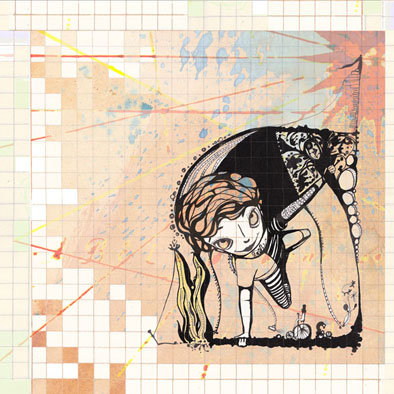
Juliet is a family secret. She is rarely seen, though she sits in an open arbour, leaves falling when she is sad and plants growing when she is glad. She lives with Mr Dignam, a talented performer flying over the circus floor as a trapeze acrobat, and Shakti, a child who exudes an inner power, lightening flowing from her body. Then there is Betsie who likes the way her body bobs in and out of sea water, tambourine playing Stella who hails from the desert and restful Theri who is taking a break before his next big adventure. However unique these characters may be, it is nothing compared to their living arrangement. For you see, Juliet, Mr Dignam, Shakti, Betsie, Stella and Therri do not live as we live. They are the imaginary friends of Melbourne-based illustrator Josephine Bradley Scott; the characters exist in her mind and come out to play in her art.
Along with her myriad of imaginary companions, Josephine is a special character all on her own. There is sensible Josephine, who works with pens and inks on objects that are found, from shoes to photo albums to the back of the back of an old mirror where Juliet is hiding. And then there is her street alias, Yoyoe, who experiments with mediums such as aerosols and paint where her canvass is the street and human bodies.
Josephine’s artwork has been described by many of those familiar with her work as “whimsical, magical and mysterious”; her illustrations capture feelings of an inner child, each with a wide eyed optimism, and a contentedness of self.
“Each of my characters have a real familiarity about them, but there is something magical about them at the same time…They have a kind of self-reliance and look really content. That’s not to say they’re happy go lucky sort of characters, they are just true. They’re really sure of themselves.”
Her current exhibition on display at a subterranean bar in Elizabeth Street known as E FIFTY FIVE is called “Imaginary Friends”. Here, some of her imagined personalities come to life on different platforms, from a table, to canvas, to tiles, to embroidery panels and even an old television set.
E FIFTY FIVE has become a source of much inspiration for Josephine, with its laid back surroundings and its diverse clientele offering her stories and ideas in which new characters are born. Her family is also featured in her illustrations, if not directly then in spirit; the character of Juliet is named after Josephine’s niece.
Born in the industrial city of Whyalla, South Australia, and having a sister quite a bit older than her, Josephine would draw in lieu of having someone to play with when she was in a world full of older people. It is little wonder then how such a vivid imagination was born. While it is estimated that 65 per cent of children will have an imaginary friend in the first eight years of their life, for Josephine, the reverse is true.
“I probably have imaginary friends more so now than when I was little. They come out through the characters in my illustrations. A lot come out through Yoyoe. There’s just too many to count.”
However despite the innumerable number of friends she Imagines, Josephine manages to name every one of her characters. Sometimes the names will just come to her when she finishes a piece, sometimes she will have a sense of a letter and a name develops from there, while other times an image friend will develop from a name she has discovered, like Shakti which is an Indian word that describes inner power and strength.
The characters each have a unique meaning to their creator, often stories of her childhood come out through her illustrations. Other times they will come out of someone she has met, recreating their imaginary shadow, an extension of their soul that can be transformed into a work of art; like Mr Dignam, who developed as one of Josephine’s friends studied circus performance.
She enjoys seeing beauty in the world, finding its various manifestations in different people’s expressions as well as in her surroundings.
“You often only get exposed to one type of beauty, one idea of what beautiful is, but truly there are so many types of beauty. There is such a diversity…It has become unnecessarily common for us to be cruel to ourselves and others by the default of comparison. I hope to change this by offering an opportunity to reconnect people with what it is that makes them unique, interesting and beautiful.”
This is probably what makes Josephine such an ideal mentor at the Footscray Community Art’s Centre “Arts Convoy Program”. During the program, Josephine will be engaging with young women about their ideas of body image, about what they do with their bodies and how they engage with themselves. She will be doing this through her art, using body painting to help the girls see their bodies in new ways and start to think about what their bodies mean to them. It will be about what people do with their bodies, not just what they put on their bodies or do to their bodies.
Findings from a Victorian Adolescent cohort study revealed that over eight per cent of female adolescents had an eating disorder, while most suffers tend to deny they have an eating disorder. Consequently, body image is an issue of real importance to this young artist and as an activist she provokes people to revisit their ideas of beauty through her illustrations of inner children and imaginary friends. Having battled through an eating disorder for four years, Josephine decided during her recovery that she would one day do something positive with the experience. She believes it is important to learn from mistakes, and acknowledges that it isn’t always easy to talk about personal struggles. She sought to change this and keep true to her recovery promise.
In 2009, after a hiatus from full time illustrative work following the completion of her university studies in 2007, she felt a real need to get back to her passion and really do something big with her illustrations. That paired with her experiences in overcoming an eating disorder, Josephine approached the Butterfly Foundation and the “These walls can talk” exhibition was born. She felt that there wasn’t really a safe place in which young people could discuss their experiences combating body image issues and where they could really be proud of what they had overcome and of their bodies. The illustrations she produced in anticipation of this cooperation became a way of her becoming at peace with all that she had gone through and all that she had achieved.
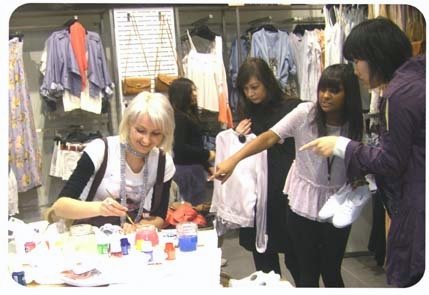
The exhibition, in which the proceeds were donated to the foundation, opened up a world of opportunities for Josephine. Later that year, she collaborated with Sportsgirl for hope week and the opening of the Chadstone flagship superstore where she could be seen personalising products such as shoes. This collaboration also involved working with the Butterfly Foundation, and her connection with the organisation was further entrenched. She hopes to collaborate with the foundation for another project hopefully later this year or early next year, however nothing is definite yet.
“I’ve got actually got a meeting coming up with them soon…nothing is confirmed. There are some pretty amazing women involved with the foundation. I think in the next five to ten years we’ll be seeing a real change in the way we see body image and hopefully there will be more public dialogue about eating disorders and the way we perceive our bodies. And more diversity in the images that are seen in advertising, which is starting to happen now, but I would like to see happen more fully.”
In many ways, Josephine’s illustrations are transformative. They represent a journey, a survival, a celebration and recognition. One of her first illustrations that she has a record of is a drawing titled “Josephine draws ‘fiders’” which is a picture of spiders that she drew when she was two years old.
Spiders are something that Josephine sees everyday now, but they used to be creatures she was fearful of. However after learning of an old story in which an ancient king describes a spider’s web as the universe, in which every link is a connection made with someone and every droplet affecting another point on the web, spiders became a real thing of beauty.
“I think there is something really beautiful about the metaphor contained in the story. We’re not just individuals, we are all connected to something bigger…personal relationships are really important.”
Josephine believes in sharing the creative process with others, feeling it is important for people to see not only the finished project, but what happened in between. This way the community becomes involved in her work and her characters can inspire people while people inspire her.
Josephine’s “Imaginary Friends” exhibition at E FIFTY FIVE, 55 Elizabeth Street, is a collaboration with fellow artist and lover of the make believe, Rhiannon Mowat and ends this Wednesday 3rd November. She will also be part of a group exhibition in February called “The Shadow Project”.
To enquire about personalised illustrations or “image friends”, activism or upcoming events please visit http://findjosephine.com.
-
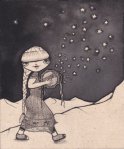
- Stella – an imaginary character brought to life in art

-
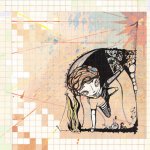
- Mr Dignam – circus character modeled after one of Josephine’s friends
-

- Josephine Bradley-Scott at Sportsgirl Live Art event
 Chani Unger